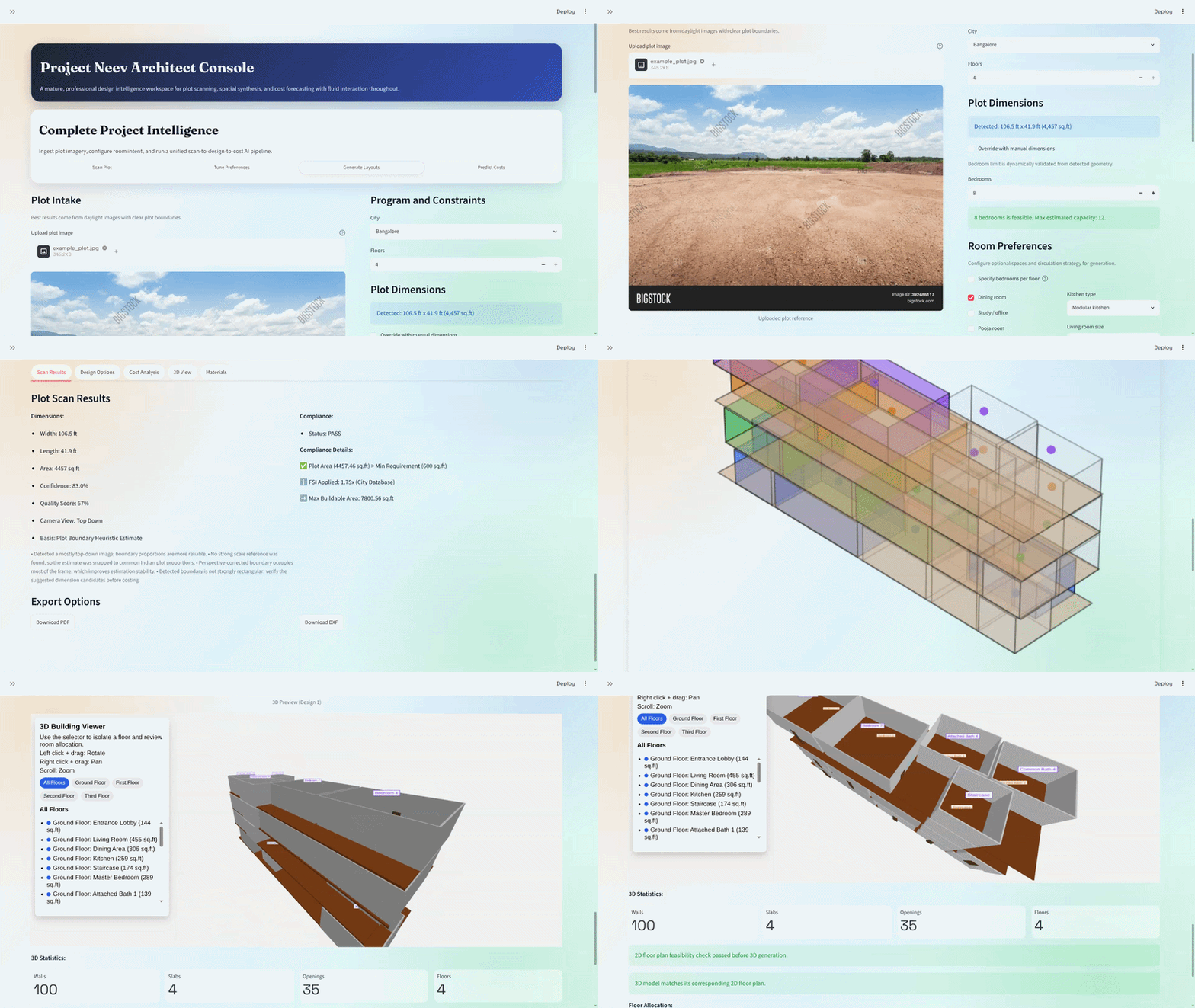
Send a photo of your plot.
Neev returns the build.
An AI construction pipeline for India. Neev reads the plot from any site
photo, checks it against local bylaws, evolves legal floor plans, prices them
against CPWD rates, and exports the drawings a contractor can actually build from.
A live run from the actual app — plot scan to generated plans, priced and modelled,
in a single pass.
FastAPI
Pydantic v2
Streamlit
scikit-learn
Shapely
Three.js
Docker
The pipeline
Eight stages. One run.
Neev is a single connected pipeline, from the raw site photo to the export a
contractor will open. No file shuffling between vendors — every stage hands clean
data to the next.
01
Scan
Computer vision extracts plot dimensions and obstructions from a site photo.
modules/scan
02
Regulate
FSI, setbacks and ground coverage checked against the city's bylaws before a wall is drawn.
modules/compliance
03
Generate
A genetic algorithm evolves 3–5 layout alternatives scored on efficiency and circulation.
modules/design
04
Price
ML predictions calibrated against a deterministic CPWD DSR 2025 BOQ, with confidence bounds.
modules/estimation
05
Model
Rooms extrude into textured 3D — viewable live in the browser via Three.js.
generate-3d
06
Specify
Material engine matches brands to budget tier with a five-factor sustainability score.
material_engine
07
Export
DXF CAD with layers, PDF reports and standalone 3D HTML viewers generated on demand.
export-dxf · pdf
08
Deploy
Dockerized backend and frontend behind Nginx, health-checked and ready to scale.
docker-compose
37Cities & towns indexed, calibrated per state PWD SOR
5Floor plans per run, scored on efficiency & circulation
~2 sML cost prediction with calibrated confidence intervals
3Export formats — DXF, PDF, standalone 3D viewer
Product
Engineered like a build plan, not a slide deck.
Every system here solves one real headache on an Indian site. Three systems carry
the pipeline; the rest of the stack picks up the paper around them.
01 · Design
Genetic algorithms that evolve layouts, not templates.
Constraint-satisfaction across every room — adjacency, daylight, circulation and
bathroom placement — iterated over hundreds of generations. Neev doesn't stitch
rooms together from canned blocks; it breeds a plan to fit your plot.
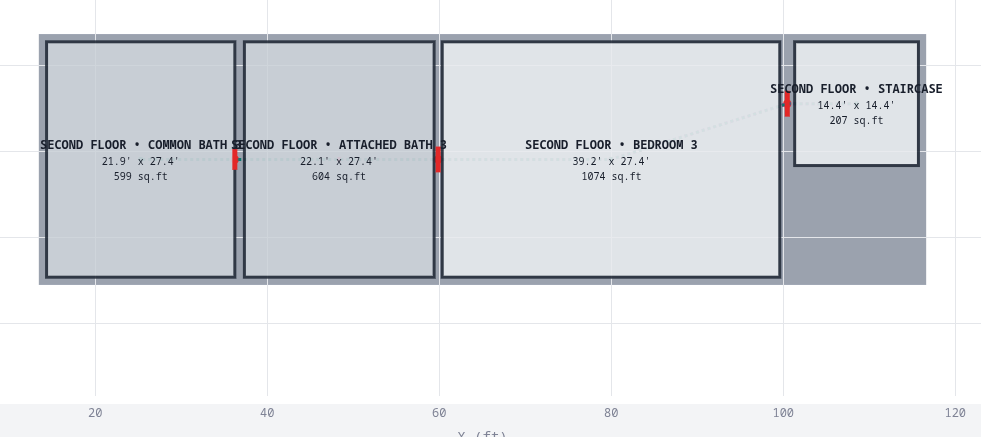
Floor plans straight out of the app — dimensioned and scored, ready to hand to a
draughtsman. The same geometry seeds both the cost estimate and the 3D model.
02 · Cost
A price you can defend against the DSR.
A Random Forest trained on CPWD DSR 2025-aligned data is blended against a
deterministic government-published BOQ. When the ML model and the DSR disagree,
the estimate shows you the gap — and the confidence band around it.
Deterministic CPWD BOQ + ML blend, not one guess
Confidence intervals on every line item
Live rates via Konnbot API → IndiaMART → CPWD seed
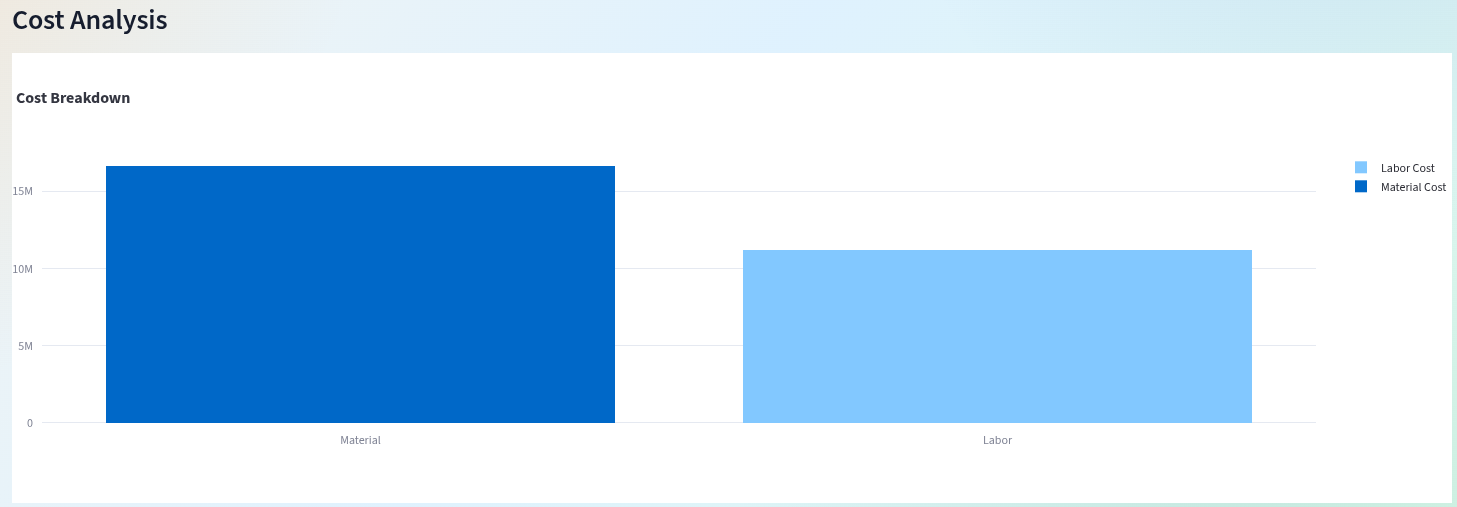
Neev · Cost — breakdown
A real estimate from the app — CPWD-based line items, city multiplier applied, with
the ML prediction held next to the deterministic figure.
03 · Deliver
Drawings contractors read, files computers use.
The 3D model is extruded straight off the generated plan — no manual rebuild — and
exports are produced with the same geometry. The DXF opens in AutoCAD with proper
layers; the 3D viewer runs from a single HTML file on any computer.
Layered DXF: walls, rooms, dimensions, fixtures
PDF report with BOQ, plans and cost breakdown
Standalone Three.js HTML viewer, no install
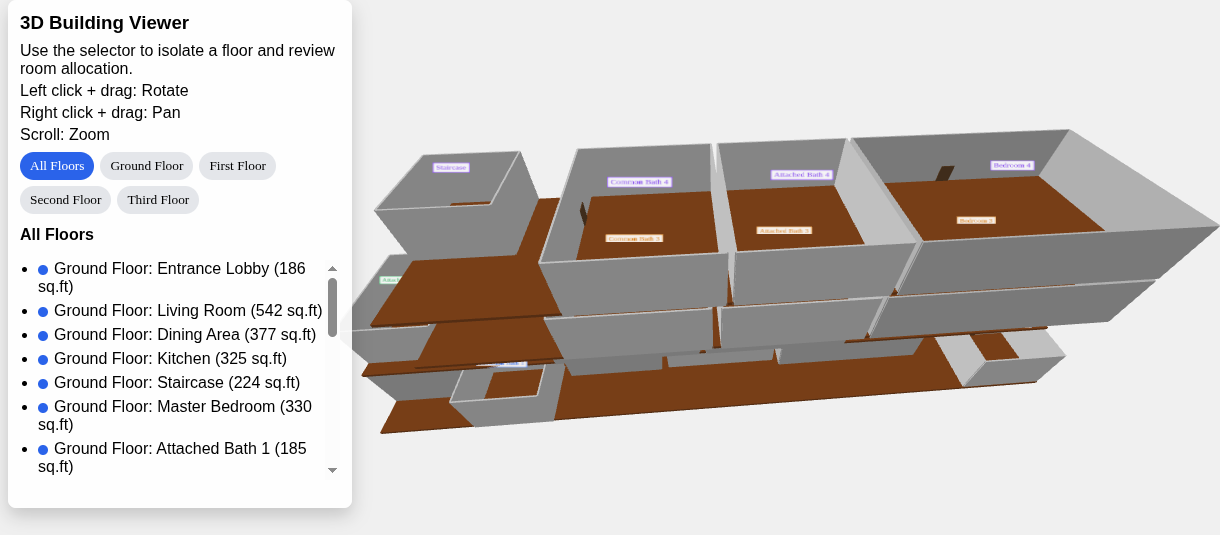
Neev · 3D — interactive viewer
The extruded model in the Three.js viewer — pan it, orbit it, walk the floors — and
the same geometry also drives the layered DXF export.
Datasheet
The rest of the stack, on the record.
The support systems that make the three above hold up in production — each one
small, typed, and unit-tested.
Plot scanner
OpenCV extracts plot edges and usable footprint from a photo, cross-checked against manual dimensions.
scan_routes
Bylaw engine
FSI, setback and ground-coverage rules per city. Bangalore and Delhi carry formal BDA / DDA references.
states_data.json
Material engine
Five-factor scoring across a brand catalogue — cost, availability, strength, finish, sustainability.
material_engine.py
Live price feeds
Konnbot API → IndiaMART scrape → CPWD DSR 2025 seed, refreshed on a seven-day cache.
update_prices.py
Delivery
Two containers — API and Streamlit — behind Nginx with health checks and rate limiting.
docker-compose.yml
Contracts
Every request and response typed with Pydantic v2 and versioned under a single /api/v1.
app/api/v1
Workflow
Site visit to submission, in five steps.
01
Upload a plot photo
Or type dimensions straight in. Nothing to install; Neev runs in the browser-facing Streamlit app.
02
Set parameters
City, bedrooms, floors, and room preferences — pooja, study, servant quarter, kitchen type, bathrooms.
03
Run the analysis
Design, compliance, pricing and 3D all fire in one call. A few minutes of compute for a full package.
04
Compare alternatives
Plans ranked on efficiency, circulation and external-wall ratio, with cost broken down per alternative.
05
Export deliverables
Grab the DXF for a draughtsman, the PDF for the client, and the 3D HTML for the site meeting.
Pricing data
Rates calibrated city by city.
Every estimate is anchored to each state's PWD Schedule of Rates, relative to a
Bangalore baseline of 1.00 — CPWD DSR 2025 for Delhi. No national "one price fits all".
…plus every remaining district in India, banded by state PWD SOR calibration.
Bangalore 1.00Delhi 1.15Mumbai 1.22
For developers
A typed API you can build on.
Pydantic-validated requests, synchronous JSON responses, and a pipeline that fits
into any estimator or floor-plan product. The whole thing runs on one machine if
you want it to.
Deploy Neev's Engine Inside Your Firm or Client Portal
Neev's typed FastAPI backend (CV plot scanning, municipal bylaw validation, genetic floor-plan generation, CPWD BOQ estimation, and automated AutoCAD DXF/Three.js exports) can be white-labeled or custom-calibrated for real estate developers, EPC contractors, and PropTech agencies.